
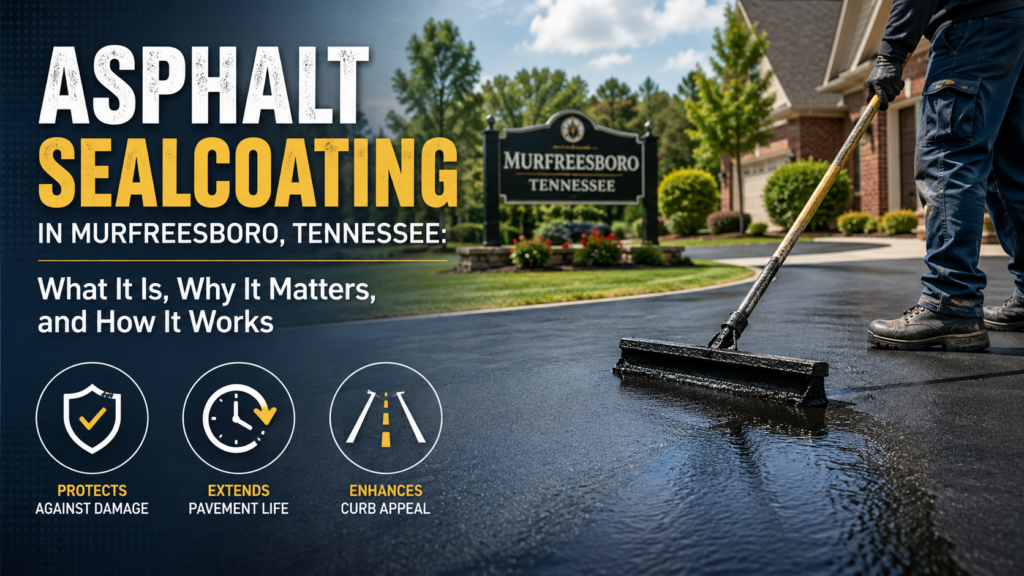
Murfreesboro is one of Tennessee’s fastest-growing cities the county seat of Rutherford County and home to Middle Tennessee State University, with a rapidly expanding population and a construction boom that has brought new residential subdivisions, commercial developments, and institutional facilities across the region. All of this growth means an enormous and growing inventory of asphalt pavement that needs to be maintained, and Asphalt Sealcoating Murfreesboro is the most cost-effective maintenance tool available to Murfreesboro property owners. This guide explains what asphalt sealcoating is, why Tennessee’s climate makes it essential, and what the application process involves.
What Is Asphalt Sealcoating?
Asphalt sealcoating is the application of a liquid protective coating over an existing asphalt surface. The sealcoat material typically coal tar emulsion or asphalt emulsion is applied as a fluid that fills surface micro-voids and coats the aggregate and binder at the surface of the pavement, then cures to form a continuous protective film. This film provides the primary barrier between the asphalt surface and the environmental forces that cause deterioration.
Sealcoating does not repair existing damage it is a preventive maintenance service, not a repair service. Cracks, potholes, and structural failures must be addressed through appropriate repairs before sealcoating is applied. Sealcoating over existing damage will temporarily hide the damage but will not prevent it from continuing to develop. The proper sequence is to repair existing damage first, allow repairs to cure, then apply sealcoat to the prepared surface.
Why Tennessee’s Climate Makes Sealcoating Essential
Murfreesboro experiences a climate that creates significant demands on asphalt through multiple mechanisms. Middle Tennessee’s four distinct seasons include hot, humid summers and winters with moderate freeze-thaw cycling Tennessee averages 20 to 30 freeze-thaw cycles per winter in most years, which while less severe than Pennsylvania or Michigan, is sufficient to cause meaningful freeze-thaw damage to unprotected asphalt.
UV radiation is a primary deterioration driver in Murfreesboro’s climate. Tennessee receives more annual sunshine than northern states, and UV radiation from the sun initiates a chemical process called binder oxidation that causes the asphalt binder the petroleum-based material that holds aggregate particles together to harden and become brittle. As the binder oxidizes, the surface loses flexibility, turns from black to gray, develops surface cracking from thermal stress, and begins to ravel (lose surface aggregate). UV oxidation is the reason asphalt surfaces look gray and rough after several years without maintenance.
Murfreesboro’s rainfall roughly 53 inches annually creates substantial water exposure for pavement surfaces. Water infiltrating existing cracks reaches the aggregate base, saturating and weakening it, and creates the conditions for freeze-thaw damage in winter. Tennessee’s thunderstorm patterns produce intense rainfall events that can sheet-flow across pavement surfaces, eroding deteriorated asphalt edges and washing aggregate from raveling surfaces. Sealcoating provides the water-resistant film that prevents infiltration through the surface.
Oil and fuel contamination from vehicle drips and spills is particularly damaging in parking lots, where vehicles idle and park for extended periods. Petroleum products dissolve asphalt binder on contact, creating soft spots that deform under traffic loads and eventually develop into potholes. Sealcoat material is resistant to petroleum contamination, providing a barrier that protects the underlying asphalt from oil and fuel damage.
The Sealcoating Application Process in Murfreesboro
Professional sealcoating in Murfreesboro begins with thorough surface preparation. The pavement must be clean free of dirt, oil stains, vegetation, and loose material for the sealcoat to bond properly. Oil spots are treated with primer or spot treatment before application; untreated oil spots will repel water-based sealcoat and result in adhesion failure at those locations. Edge vegetation is trimmed back, and cracks are filled if not previously addressed.
Sealcoat is applied using commercial spray equipment (for larger lots and areas) or squeegee application (for driveways and smaller areas). Professional contractors apply sealcoat in two coats to ensure complete coverage and adequate film thickness. The first coat seals the surface; the second coat provides the protective film thickness and uniform appearance that delivers the full performance benefit.
Drying and curing time depends on temperature, humidity, and direct sun exposure. In Murfreesboro’s warm-season conditions, sealcoat is typically dry to the touch within one to two hours and ready for vehicle traffic within 24 to 48 hours. Applying sealcoat in cool, humid, or overcast conditions increases drying time. Professional contractors in Murfreesboro account for weather forecasts when scheduling sealcoating projects, avoiding application when rain is expected within 24 hours or when temperatures are below 55°F.
The ideal sealcoating season in Tennessee is May through October after the freeze-thaw cycle ends in spring and before winter salt season begins. Scheduling in late spring or early summer allows the sealcoat to fully cure before the hottest summer temperatures arrive and provides maximum protection heading into fall and winter.
How Often Should Asphalt Be Sealcoated in Murfreesboro?
For residential driveways in Murfreesboro, sealcoating every three to five years is the generally recommended interval, with new asphalt waiting at least 90 days (and ideally one full year) before the first sealcoat application. This waiting period allows the new asphalt to fully cure and harden before the sealcoat is applied. Commercial parking lots that experience heavier traffic and more intensive use may benefit from sealcoating every two to three years.
The visual cue that sealcoating is needed is the color of the asphalt surface. Fresh asphalt is dark black; well-maintained sealcoated asphalt maintains a similar dark appearance. As sealcoat wears away and the underlying asphalt oxidizes, the surface color transitions from dark gray to lighter gray. When the surface has turned uniformly gray and surface cracking is beginning to develop, it is past due for maintenance.
Common Questions About Asphalt Sealcoating in Murfreesboro
How long does sealcoating last in Tennessee? Under normal traffic conditions and typical Murfreesboro climate exposure, a quality two-coat sealcoating application lasts three to five years on residential driveways. High-traffic commercial lots may see faster wear. These are general guidelines actual service life depends on traffic volume, the quality of the application, and weather conditions during the curing period.
Can sealcoating be applied in hot summer temperatures in Murfreesboro? Yes. Murfreesboro’s summer heat with temperatures frequently in the 90s is within the acceptable range for sealcoat application. In fact, warm, dry, sunny conditions accelerate drying and curing, which is beneficial. The important constraint is that the sealcoat must be applied on a day when rain is not expected and temperatures will remain above 50°F throughout the day and into the evening.